

March is for...
“The disaster changes shape, and it becomes tomorrow’s joy or whatever.”– Steve

“The disaster changes shape, and it becomes tomorrow’s joy or whatever.” – Steve

…Melancholy
Not to be all moody, or whatever, but I would like to know when Misery took my measurements. (Was it at night, through all those restless sleeps February kept tumbling down on me? Was that why I would wake up every hour, half-hour, two hours, three-quarter hour, five-eighths, 57 minutes, and so on?) Then, I would like to know when Misery found the time to collude with Sadness on a colour palette. Then, I would like to receive a transcript of the conversation the duo had to bring Despair on as a designer. They looped chains and bedazzled bitterness into an outfit so precise, the areas where it’s loose and tight fitly remind me that I am miserable. Abundant care was placed into how best to cross-stitch my confidence, what weather conditions go well with drudgery, the exact number of attempts mandated to let me out of bed. Special threads organically sourced and subsequently drenched in black bile. Inspired by a spider’s chapel in the 6AM light; bowed, drooping, dripping with clumps of penitent remorse. A HYPEBEAST collaboration for Lethargy. A high fashion, technicolor robe that leaves me nothing but poor. As they sewed it to my body, stitch-by-stitch, enabling this slow descent from Goodness to Mid-ness, they asked that I reserve it for special occasions – ones where I’m a bit unmoored, a tad exhausted.
Acquiescent, my spine curves beneath this cloak till I am an abject pile of misery. Unwashed, but a puddle of utter discontent rippling at each new request in my inbox or alert inconvenience.
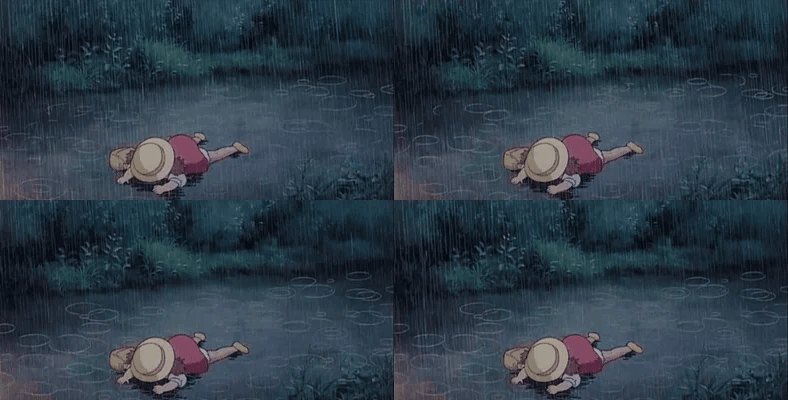
What’s gotten into you? Good question.
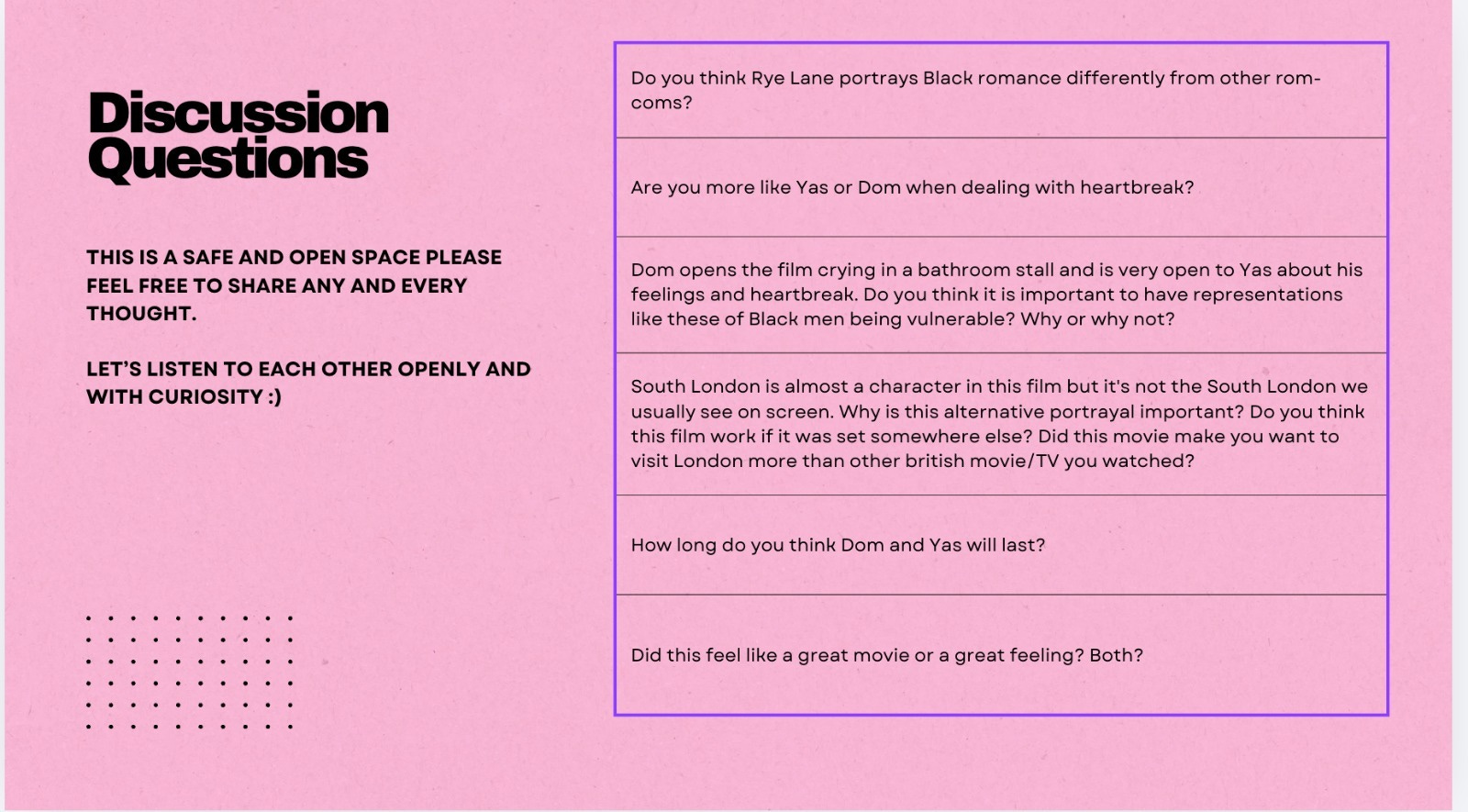
Better question! In Rye Lane, “Dom opens the film crying in a bathroom stall and is very open to Yas about his feelings and heartbreak. Do you think it is important to have representations like these of Black men being vulnerable? Why or why not?”
The better question was posed by my brilliant friend Marie-Reine after hosting a Rye Lane watch party - s/o Afrovideodrome!1 I wasn’t able to hear the group’s conclusion, what with me being constantly on the move and late for another event, but in the moments before I skedaddled, one of the three homies present did answer. Part of what he said wormed its way into my psyche and has been spinning away the entire month. The jist is that it’s presumptuous to assume the sole way a Black man can be vulnerable is through crying; and, talking about how your emotions is part-wasteful, part-whiny – as a man, you should handle it. Forgive my paraphrasing, grace and nuance probably fell out while I was stuffing a foot into a shoe. But I easily agree with the former: tears can’t be the two-factor authentication required to assess a man’s emotional health. The latter, however, I keep chewing on. Because when does Goodness cross over into Whininess?
Some social (media) pseudo-scientists may dictate that if a man opens his mouth to be unhappy, he’s whiny. If he cries, whiney. If he’s glum after a sports game didn’t go his way and trots out a dappled sigh, that’s technically a whinny, but it holds the same effect – whiny. It’s very trendy now when faced with male disappointment over heartbreaks big and small to slap duct tape across their fuzzy face with the phrase; “Men used to go to war.” You know, really reinforce the perspective that we should keep pesky feelings tucked by reminding us of the trauma that turned our grandfathers mute. (At least they could afford houses!)
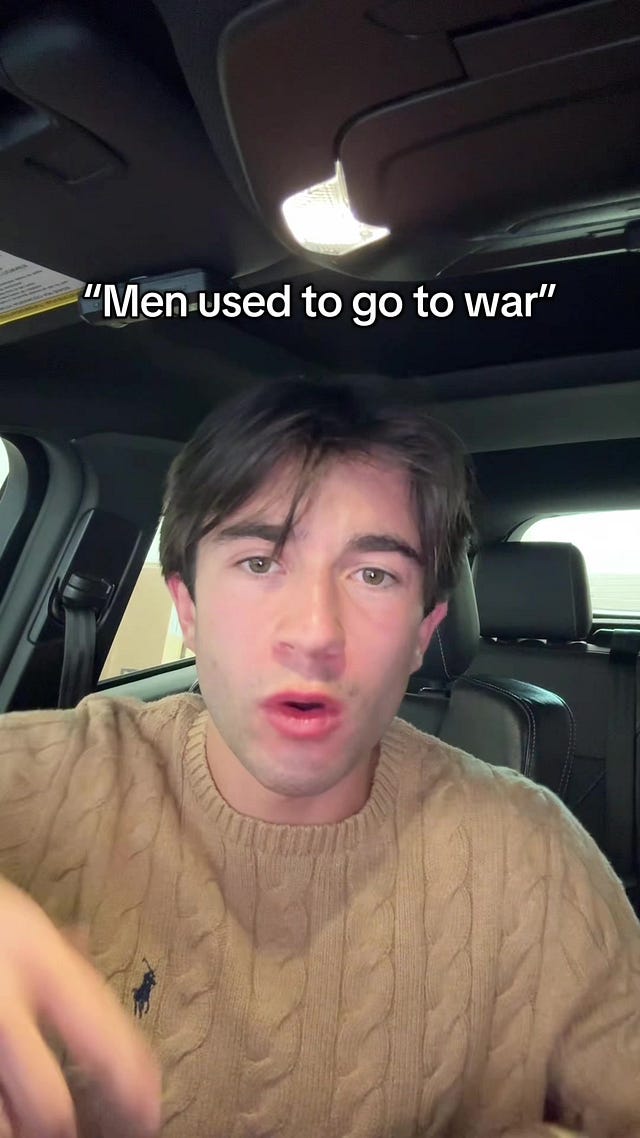
 Tiktok failed to load.
Enable 3rd party cookies or use another browser
I’ll admit right now that the trouble – all of it – is us men be online talking too damn much, and with too much damn entitlement in our tone. Fondly do I recall the days when every man was an underground producer instead of on a podcast.2 We’re unpracticed at venting with purpose, in private, without immediate solutioning, where it might actually cost us something, thereby opening the door for vulnerability. Which is important because we used to go to war…and come back haunted…emotionally stunted…unable to talk with our partners or connect with our children… and we’ve seen how that turned out.
Anguish isn’t new to us. You can’t spell “melancholy” without “men”. What you get if you try is a tipsy misspelling of the French word for alcohol, or, if you’re particularly generous, a Spanish tourist’s butchering of the word cauliflower.3
The importance in pushing past the whine was shown to me by Mimi the Music Blogger’s open and honest article, “Maybe I’m Just Entitled?” In it, while dissecting her own bout of dejection, she reminds us that, “David asked God the same kind of questions.” In fact,“Half the Psalms are basically “where are you, does anyone see me, I’m tired” and then somewhere in the middle, it shifts. The documentation itself becomes the processing.” Seems a little whining’s useful to reach the solution phase. Those gripes and grunts grease the sleeves we eventually roll before “handling it”.
Anyway, to answer your question, what’s gotten into me is the same thing that’s gotten into the weather up here. Spring in Canada doesn’t need a break – it needs an exorcism. Which might be the only way to separate me from my melancholy.
…Momentum
I come into March demanding reimbursement for everything February put me through. Day dot. 12:01. Pay me what you owe me. I come into March shaking a fistful of receipts like I’m Richie Rich’s tax adjustor. I come into March the way spit comes out of mouths whenever a person says, “A Bat outta Hell!” with any ounce of passion. Meaning I come flying, shooting, swinging, ready for my fist to land on March’s face. To March, I’m Yosemite Sam. To March, I’m a Tasmanian Devil. And I ain’t hearing no talk of “calming down” in this cold-ass, bitch-made weather. March, I’m coming for you.4
On my 27th birthday, I take my parents out to the Korean restaurant down the street because its cheap, serves large portions, which will make them happy, and its back patio always finds me at peace. Either aimless after our third lull in conversation, or maybe as a bid for connection to mark the occasion, or wanting something old to comfort me as I get older, I ask them for proverbs from Nigeria. The translation of the one my mum offers is debated and in the clutter of Yoruba they exchange falls through the cracks of my memory. But the Igbo proverb my dad shares has yet to lose its place. “When a young man runs, if he falls, he looks forward to where he is going; when an old man runs, if he falls, he looks back to see who has tripped him.” And at 28, I can feel my head turning.
Last March we had lay offs. My team, already tiny in comparison to the scope of our responsibilities, was cut in half, our company’s headcount trimmed roughly ten percent, and the shred of progress I felt we’d been building fell like a sandcastle met by an anvil. This past year, two-by-two and nearly every two weeks, I have watched coworkers depart our rotting ark for better pastures. Some talented, some less so; some eternal work besties, others semi-spited colleagues. Watched is what I did. Idle. Scared yet convinced the grass would be greener, will have benefits and RRSP matching and reasonable work hours, on the other side. I could be playing the same game with my job as I am with my dreams. Problem is only dead niggas played Chicken with the Titanic.
All of the knowledge I hold is hodge-podge. Cobbled together from crumbs and coffee chats and college classrooms and corporate internships. My worry is that’s not enough in a bad economy. That the AI HR-overlords come equipped with bullshit detectors. When I was running to it, I thought a diploma was a certificate, and when I got there, I realized it’s a receipt. Neither proof to protect me from my insecurities nor the market, just of purchase. But the bill is paid. I put the work in, and I ought to push forward. Especially as the headwinds continue to whisper what I’m missing from the criteria.
A dream goes on forever: this contract won’t. I’ve started to apply for new jobs.
Somewhere in the middle…
“The tonnage of our reality weighs on me now, but it doesn’t crush me entirely, and I believe that this is a question of my relationship to time. My past indifference to my own living has afforded me a kind of hard-earned inventiveness. I know how to get through a hard hour, a hard day, a hard week. I know how to pull myself from one minute to the next, in large part because I find that my depths of despair have afforded me a newfound curiosity. I am no longer wired to catalogue and sift through only my own internal horrors, and so, by the mercy of simply looking up and looking around, I can see that there are people willing to love me, and that I am willing to love them, and, yes, I cannot believe that this is the world we’ve got, but I am chasing the tail of the world’s end, imagining that if I catch it (by way of tidying up my own spirit, my own heart, and also my own material communities), there might be something better than the present.” – Hanif Abdurraqib, “In Defense of Despair”
Spring! Break forth from bad (work) vibes and arctic climates! Be consumed by madness and march through the boxes of your checklist, your wish list, your wants; whatever gives you a strong Q2! Make that train! Catch that flight! Move! Shake! Shift!
You serve the God of “Suddenly”.
…Marriage
I’m going to be spending a lot of time in airports this year. Waiting, idling, shuffling till I am hurtled across the sky praying to arrive in time for the date marked in the sentence after “Please RSVP by...”. Weddings. Marriage. Matrimony.
In the stale moments of a budding day, my head tips up, reversing the laws of physics like the feat the plane is about to perform, and I am struck by Love. Not inhabited; reminded of its presence, pervasiveness. Love isn’t looking at me: I am staring, silently stupefied – song paused – at it. Love looks like the shoulder you borrow before boarding. Spilling from those lukewarm chairs, desperate for comfort, whose do you lean on? Who lets you lean your baggage against their knee, wafts your morning breath unflinching? Love looks at ease.
I stare at Love unflinching, and realize, as The Lord said, “I have no place to lay my head,” to put all these thoughts to rest. Neck continuously on swivel. Clutching my carry-on and headphones clasped to both ears. The easiest thing about me is how I’ve designed an all-black outfit to glide through security. Indetectable and unbothered. As if I’m prepared to mourn whatever connection I may already have missed. Three layers sleek, Heattech strapped to ashy legs, bracing for cold weather and for snow to be the first thing that greets me. What’s colder is the flight spent hugging myself upright so as not to inconvenience a precariously placed stranger. The flight where the only thing holding me is the seatbelt around my waist.
My sister transitions from her teens to her twenties. Two cousins check the box called “Married”. Paul Thomas Anderson moves from “Three-time nominated” to “Oscar Winning”. They all look like happy pairs. Meanwhile, I’m a little blue, a little battered, a little older with a new resume, and a six-pence stuck in my shoe that security didn’t catch.
As far as delayed wedding gifts go, Paul Thomas Anderson recommending Kirsten Dunst to Lars von Trier was pretty top-tier. The Danish director, frequently in hot water for the things he says, required an exceptional vehicle to voice an experience he feared misunderstood: severe depression. Dunst performs malaise, carries it with every movement, blink, perfunctory exchange, in a way that leaves no misinterpretation. Where von Trier hoped audiences might see how depression felt for him, the grey woolly yarn he’d been trudging through, too bogged down even to speak, he was delivered an actress equally as evocative as the pictures he utilizes in his opening scenes.5 If corporate asked you to spot the difference between Kirsten’s “Justine” and Robert Burton’s “The Anatomy of Melancholy”, you would say they were the same picture.6 Except Lars’ story starts at the end, as depression often does. Earth crumples into a much larger planet, “Melancholia”, with zero hope of survival. Once this baseline of doom is established, he jumps back a few days to, well, a wedding reception, and his unsteady hand-cam shifts focus from cinematic destruction to an extra-stretch limo churning up a hill. Inside are the bride and groom, an eager but dead-eyed Alexander Skarsgård, who due to complications going up a curve arrive two hours late. What’s left of the reception, similar to von Trier’s writing, reads opaque and, at times, oddly specific: capricious parents, cake cutting, copywriting, cha-cha real smooth, copulating with the intern. I guess that’s meant to relay life’s frivolous, pointless nature when you’re in the grips of despair? At the mercy of its orbit, the most basic rituals, like lifting a leg for a bath, or carrying your beloved into the bedroom, become painstaking, incredibly trivial.
Besides some background covers of “La Bamba”, the sole piece of music in this film is Wagner’s Act 1: Prelude to Tristan und Isolde. Muted tremulations and swelling hums foretell the tragedy of desire delayed in its fulfilment. Wagner saw the rituals his contemporaries clung to when composing operas as powerless, and instead, chose to deploy “unresolved dissonance and intense chromaticism” to heighten his leitmotif of longing. Presumably, this is what lent him well to Lars – two rebels without a cause – since he was already leaning on Tarkovsky with his approach to music refrains:
“I find music in film most acceptable when it is used like a refrain. When we come across a refrain in poetry we return, already in possession of what we have read, to the first cause which prompted the poet to write the lines originally. The refrain brings us back to our first experience of entering that poetic world, making it immediate and at the same time renewing it. We return, as it were, to its sources.” – Andrei Tarkovsky, “Sculpting in Time”
The source being pain.
From the same solemn spout comes the story of a troubled all-boys school that can’t quite catch a break. Steve is every teacher’s worst day. Hell, it’s my worst day as an RA’s worst day. I can’t unpack it without spoilers – a good reason for a man to be tight-lipped – and I’m in disbelief at how much they managed to fit into Stanton Wood Manor in 1996. Food fights. Documentary Interviews. Visits from Parliament. Relapses. Workplace Harassment. Asking for a job promotion. Without scratching the surface on the stressful parts. My biggest takeaway from director Tim Melantis and writer Max Porter’s adaptation of his novella “Shy”, is that they want you to know delinquents do have hearts, they just also had hard upbringings that engendered complex issues. Which is why they, The (Cinematic) State, employ Cillian Murphy as “Steve”, the titular, teetering, sympathetic headmaster. His somber eyes and sentimental close-ups humanize these lads, beyond chaos and fury, till tears cloud your sight. But don’t blink! Because if you’re shellshocked from their gun fingers and profanity, you’ll miss what he sees in the whirling cameras and crashing dish pans. Oh, and did I mention Little Simz is in this?
Any good DJ knows that the BPM you begin with and the BPM you end on are worlds apart. Same goes for Music Supervisors. That’s why Ian Neil, right after the title card, starts us off on a leisurely note (“Deep Shit, Pt. 1 & 2” by Kruder & Dorfmeister) barely teasing the propulsive entropy to come. Teasing is also an essential part of a good mix. So Neil grants us just enough of whatever music’s blasting through a character’s headphones to let it bleed through our speakers. We get repeated small doses of the drum-and-bass Shy, a despondent Jay Lycurgo, loves jamming to as his day, which starts with being disowned by his mother, goes from bad to worse. Steve calls this top-to-bottom, nowhere to escape sound “dark” after one taste. I’d call it black. Like the DJ Ss song Shy rinses right before his emotions explode on a chair. (This poor chair. Thankfully, it didn’t press charges!) Black, like his future without the radical car of this institution. Black, like Lycurgo’s eyes whenever he slips beneath the melancholy. Black, and banging to be free.
Lord have mercy on me and my melancholy. Lord, “Have Mercy” by Eryn Allen Kane playing in a movie I watch soon. I know it’s already been synched because it scratches my brain in the part that pricks up when doctors mention shots I received in elementary school. I received her voice a few years later. What I like in this metaphor is how it likens Eryn Allen Kane to a cure, imbues her already lustrous voice with healing properties and lets me nudge it nearer to a lineage that reinforces why black people created the Blues. Metaphors like this allow me to write long sentences like that which lead me to simple truths: Mercy is medicine for what’s keeping you blue. Music is medicine for what’s eating you. Mercy is Music…and now I’ve made a tune.
Chorus:
You don’t have to keep hurting yourself.
You don’t have to keep hurting yourself.
You don’t have to keep hurting yourself.
There is now no condemnation.7
March is for many things, but we made it through. Even if…
P.S. Make the adjustments.
More of her & Mike’s great questions:
Soundcloud never hurt nobody, only made for an uncomfortable car ride!
You don’t know how deeply I was hoping this would connect to E. Coli – now that’s a real epidemic!
I’m so sorry, I’m such a boy, I couldn’t resist this Trevor Noah joke…
Two, technically. Charlotte Gainsbourg was otherworldly.