

Pushing the Envelope
"Cut to the part where you’re there.”– Sam Rothenberg

“Cut to the part where you’re there.”– Sam Rothenberg
A Brief History Lesson
Have you ever wanted to go to space? It might be childish to admit but the thought doesn’t occupy my mind much, never really has. I’m not Elon. I got two feet on the ground and I like ‘em there. Why should my head be up in the clouds? Earth seems like a nice, natural boundary. What’s there to wonder about “out there” before, at worst, it comes down here? But Man was once obsessed with the big, blue sky, and the sparkly darkness beyond it. He saw birds and thought, “How can they.” He watched stars and whispered, “What if.” He launched himself against a clear ceiling until the day it took longer to fall down than to go up. And that was flying.
Free from the ground, he had invented a new form of physical escapism. Wings were put on skinny boats and the dream remodeled and resold, like the identical phone Apple used to place you in The Cloud. And not to be that guy, though to ensure we’re all perfectly clear: escapism has long been the white man’s favorite pastime. Christopher Columbus was never “noble”, just nosy while running away from his mistress, his mother, and a guy he likely owed money. Escapism is why white people predominate and flood finances into the four A’s that paint them “Heroes”: Army, Airspace, Advertising, and Acting. Don’t worry! It will wash off with the War Crimes. Or the Sexual Misconduct hearings. Or the DE&I blast that’s posted to Glassdoor. Give it another rinse of dough; pay her a couple more thousand; cut him a cheque for an extra week’s pay. Black people understand we’ve got enough problems on land to not go looking for more trouble in the skies. This was also our prevailing sentiment at the time.
However, I’m no less grateful for the seven white men who solely sought to keep escaping. Their singleness of mind, their sacrifice to not cling but break the clear ceiling. Inadvertently, one from their ranks, the aeronautically accomplished Chuck Yeager, broke the sound barrier along the way. That’s how bad they wanted it. An ear-poppin’, Earth-shattering determination to reach the Moon. The Right Stuff, indeed. Which Tom Wolfe knighted them in his titular book, canonizing Project Mercury’s mantra: “push the outside of the envelope.”
“To push the envelope means to surpass normal limits or attempt something viewed as radical or risky. It comes from the aeronautical use of envelope referring to performance limits that cannot be exceeded safely. The phrase was originally limited to space flight, before spreading to other risky physical accomplishments, and finally metaphorically to any boundary-pushing activity, such as art.” - Merriam Webster Dictionary
If you haven’t been paying attention till now, I’ll summarize then flip. A bunch of nerds kept talking about their model planes like postage. We, the public, caught wind of their catchphrase and were great revisionists. Our version goes on to be the defining cultural idiom for breaking expectations. A plane no longer flies this far and that fast. I’m no longer worthy only when providing value. Push the envelope and see what happens when you go a little further.
Goodbye Performance Review
When I read the tweet that starts “I’m so tired of all these Forbes ‘40 under 40’ lists…”, my first thought was “40!?! Dear God, can I make it to 40? 25 is already too much of a struggle.” Five months unemployed. At the beginning of a recession. In the middle of winter. And I’ve just started dating a doctor (to be). A vacation was needed from what my parents tactfully call “my vacation”. Steal me in a warmer climate, please, with a warmer vision of the world, and leave my sorrows behind on this frozen tundra. Escapism.

I had not planned for this. The skyscrapers I held up as ambitions were partially achieved - work at a Unicorn, graduate from NYU, live in France - with new developments on the way. These present difficulties were not in their schematics. But success is like a drug; failure its dealer coming to collect. Do not let the debt get too high before it distorts your vision and disorders your brain. Now that it has, I can’t tell if I’m less ambitious than my younger self or more wary of the snakes involved in climbing the corporate ladder. I’m certain I’ve lost my confidence. Cognizant that the outcome to each meeting is a roll of the die. Once bitten and twice as shy to hand-raise at the sound of “opportunity”, that troublesome word.
It can be hard to recognize when you’re evolving, and not feel the anxiety of a factory worker each time her CEO says “pivoting”. I’ve learned we only talk about Achilles’ heel or throw out all his exploits. No in-between. When heroes are alive, and Slack profiles active, we either see the sparkle in our employees or we see the specks in their performance. We don’t weigh in on their eyelashes, callous hands, birthmark, slightly bigger toe, or taught muscles until after they’ve expired, like a coroner. Perhaps that’s why losing a job feels so similar to bereavement. The double whammy being that I lost my job due to grief. There was a change in me: less pep in the step, limited confidence on the call, added mistakes in the meeting invites; two birds, one stone. Things could have been fine but then we got busy, and the team culture dissipated, and with it any reason to keep a “culture hire” such as myself around. It’s common knowledge no Queen pays for a sad clown. So off with my head (and off to Vegas for the annual leadership conference). If, though, I am to fill out this reflection truthfully, then I must admit; I was not a fit for this role.
The harder truth to reconcile is how much of a monster, how much harder my heart became to fit said role. That, too, was why I was fired. I failed to become monstrous enough, and so failed to perform duties as expected. Not laid off, because that would have been impersonal, but strategically ambushed on the morning of my performance review. Peers were prevented from singing my praises or coming to my defense. They rushed me out the back door before our weekly standup with no word to HR apart from the pink slip in an email. Truly savage. Yet, I miss the safety, as we all do with abusive relationships. Deep breaths interject the reminder: “You are not the first person to get fired and you will not be the last.”
These mornings, I wake up at the starting line of a race I have already been running. Here is where I was supposed to be a year ago. Before a funeral, and a fire, and now a firing ejected us down a tumultuous path. Back at the starting line (or unemployment line) with a familiarity that feels bizarre. Because I know this feeling in writing, when you sit down to the page after weeks or months of planning the start of a particular passage, until something else comes out - takes over and takes energy - demanding to be dealt with first. Once you’ve finished with it, exhausted, you glance at your original sentence the next row over, and blink, “What was I thinking?” I know this feeling in writing, but we’re unacquainted in life. Something like dreaming, reeeeeaaaaaaaaallly lucid dreaming, maybe even sleepwalking. A memory keeps returning me to a morning late last August when I found my sister asleep on our parents’ empty bed. After the initial fright subsided that a burglar or Black goldilocks had broken in, I nudged her awake and asked what she was doing. She gave me a look that spoke, “This was always the plan.”
Push the envelope and see what happens when you go a little further. When you’re uncomfortable a little longer. When you’re unemployed a little more than you’d like. When you commit to a form or stick to a joke outside the acceptable limit. Push the envelope in how Succession did with cruelty and greed. Or how Fleishman Is In Trouble committed to normalcy and a story about malaise. Push the envelope until you break something and let that crumpled vessel be the art and your legend.
The exciting thing about Fleishman Is In Trouble is the way it’s perfectly paced against your expectations. Since I’m somewhat of a smart-ass this is horrible. Without a guess, prediction, or conjecture at the plot arch of a season in its first three episodes; without reasonable estimates for “Who fired the smoking gun?” by the 34th minute; or worse, should the showrunner succeed in getting me to second guess myself, only to double-back and confirm my original suspicion: I combust. Destroy me, like Luther or Only Murders, but never bore me. Fleishman, however, teases me. It takes tiny things out of reach before reverting to the drawing board. Am I being clear about how unsettling it is to have your mind read? When at the exact moment I lose intrigue, the charlatan turns over a new card (and occasionally the entire screen). Before I know it, it’s 3am, and I’m standing in front of an open fridge like Toby worrying about a wife I don’t have. The trick is a 2nd person narrator telling the heavily biased account of a Middle-Aged man’s mediocre Upper East Side divorce. Led with the sleight of hand necessary to steer clear obvious narrative faults, all as a trojan horse for questions about “aging, ambition, class, and identity”. Meanwhile, said narrator, the main character herself, offers us nuggets about her own mid-life collapse and the twos fated intertwining. Rule Number One of Three-Card Monte: always keep the cards in motion. (An easy requirement when two of Fleishman’s co-stars are Now You See Me 2 alums!) This story is about women, about motherhood and the universal tale of unzipping the body bag to see how your dreams died. It plays like a book, which I love because that’s hard to achieve in an era where stars tend to supersede their characters and the stories they serve. Taffy Brodesser-Akner domesticated her actors, and their gargantuan names, so thoroughly it would bring a tear to Hitchcock’s eye. She f-u-l-f-i-l-l-s each episode well past its eight-chapter packaging.
In the 6th - in the satisfying descent that comes half-way past any novel - Brodesser-Akner finally tips her hand. Her tell? No med student is that kind, not even the suck-ups. The house of cards crumbles as all three friends “tell-it-like-it-is” in a fight that reveals they’re all three corners to one shitty triangle. The acute pain of a lost sense of self drives Lizzy Kaplan to deliver, arguably, a career best monologue on desire and what the Portuguese call saudade. It falls deaf on Toby’s ears while haunting her departure - and us - from his apartment the next morning. Downtown she strolls through memory lane (and my old stomping grounds) cautioning against questions not to be asked and ending at the park where I ate my best bagels. Then, for the moment we’ve most desired, “Wise Up” by Aimee Mann starts to play. Rachel Fleishman is not dead. It’s not what you thought. Instead, the missing mother, the infamous third party, the final piece of this unsettled puzzle, sits disheveled on an opposing bench. We don’t have to examine a late corpse, but a living one. These types of placements were classic of the 2000s/2010s, and “Wise Up” the type of song signature to their ruler, Alexandra Patsavas. Longing, of the kind Libby waxed poetic for 15 minutes, and lyrics to match.
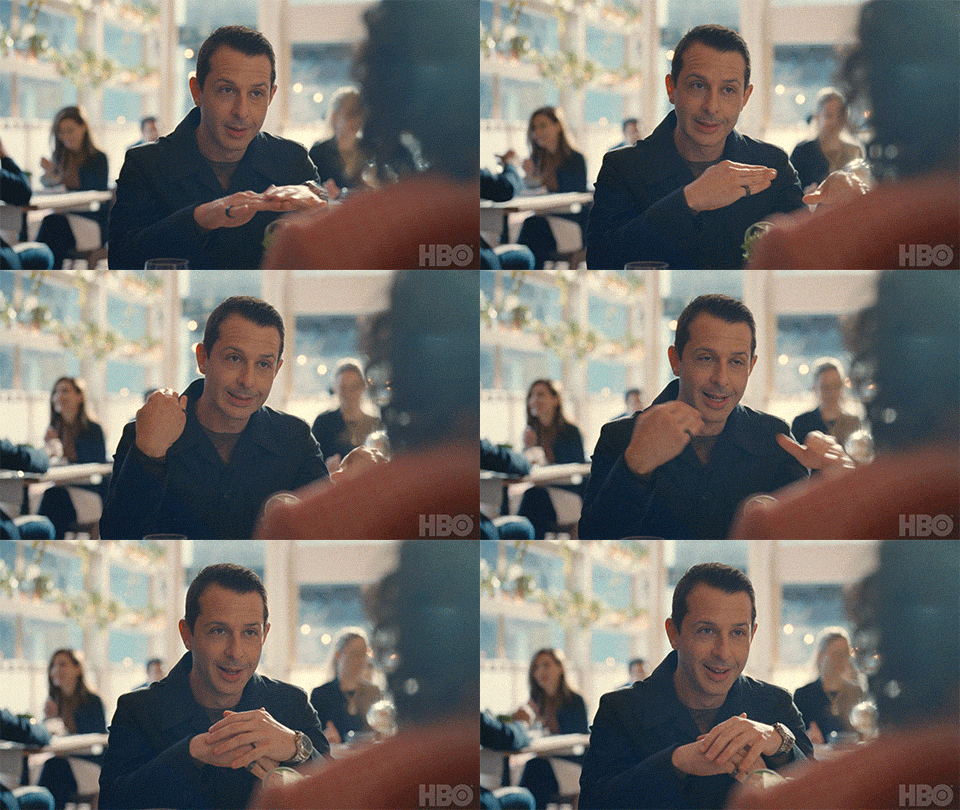
Suits is for lawyers. Billions is for bankers. Succession is for everyone in media trying to build their empire. Which in 2023 translates to EVERYONE and their grandma. (That’s probably the most original thought I’ll have about the show.) Stephen Colbert has heavily praised it as “the Best Show on TV right now” and given the deluge of content we’re wadding through from the Streaming Wars, that means more than an Emmy. Many agree with him, the Emmys included, leading Jesse Armstrong’s dark-comedy to a staggering 25 nominations. What fascinates me is how obsessed we’ve become with the program because of how obsessed we already are with the people it portrays: the uberwealthy. HBO – go team – has always been known to put out must-watch, “appointment” television. In spite of this, a successor has risen from the paltry ashes of Game of Thrones with a death grip on our attention spans I would describe as feverish. It may not be the most tweeted show of the decade, but it is among the most respected in their heralded catalogue. And although the case for love (or whether Logan and any of his four children deserve it) eludes me, I can affirm that it is shot as beautifully to the eye as it is acerbic to your morals. When I watch it, I think of Shakespeare, and that is no exaggeration to either it’s quality or importance for Western culture. Some episodes are Macbeth, there are the obvious ties to King Lear, it even dabbles with the comedies, while all of it openly displays the Kings and Queens of our modern world and the behind-the-scenes construction of their courts. On March 26th the final act begins, and Hunter Harris will hold weekly power-rankings you can swear your loyalty by.

How badly do we want to see rich white people fail? Does a limit exist for that type of Schadenfreude? Is a trust-fund debate really more legitimate than addressing SERIOUS AND CONSISTENTLY DOCUMENTED rape allegations? To the Roys, nothing is above their petty squabble. Not family. Not rape. Not justice. Not democracy. They set the stage for Shiv, newly appointed President of Domestic Operations, to address the “hullabaloo” with “cruises”. She’s a woman; they were women: Waystar Royco - “We get it.” Save for the massive amount of puppeteering, she starts her speech quite genuine. (At least for a corporation that could not give two sh*ts beyond how this might affect their upcoming shareholders meeting or sway a looming FBI raid.) When turning to the positive, “Rape Me” by Nirvana begins to blare from JBL speakers throughout the auditorium. It’s the wildest joke Succession has ever made, and I’m unsure if it lands. Kurt Cobain’s clunky, misguided words mirroring Kendall’s self-righteous deployment of Nirvana. Armstrong frequently manufactures situations that make my stomach sink but this one made the bottom fall out. Stunned they would even go there; I’m barely comforted by Shiv’s expertly craft hack into her brother’s planner. The look on Logan and Roman’s faces must have been the same as those in the writers’ room when this scene evolved - Are we really doing this? You want to know the crazy part? Fifteen minutes later I feel sorry for this cocaine addled psychopath. What an amazing show.
“Bless This Mess” by U.S. Girls would be stored in both Libby and Kendall’s iPods. It’s giving… Escape Velocity. Out-of-this-world good, Meg Remy’s latest album and eponymous single are powerful enough to break Earth’s gravity, along with my post-trip blues. Which, according to NASA, for a spacecraft leaving the surface of Earth is about “11 kilometers (7 miles) per second, or over 40,000 kilometers per hour (25,000 miles per hour);” and for a 25-year-old leaving Colombia is exactly four minutes and two seconds to exit his room-temperature bed. By now we could all use a letter from God saying, “I see you. I see what you’re doing. You’re doing your best.” But until She writes it, I’ll keep pushing the envelope and pushing that we sync this in a conciliatory scene.
P.S. Passive aggressive belongs to people you don’t like but can’t get rid of – like family. If they’re not blood, keep it aggressive.
This disclaimer informs readers that the views, thoughts, and opinions expressed in the text belong solely to the author, and not necessarily to the author's employer, organization, committee or other group or individual. :)