

A Time Distortion (Cont.)
“Your wish is granted.” - Zoltar

“Your wish is granted.” - Zoltar
Continuing!
Somewhere in the stretch of a stumbling four hours, Olivia Dean won her first Grammy. The calendar marked February 1st, 2026; an uncanny allotment from when our discussion around her magical artistry began. Weirder, still, how the first day of the Love Month ended in a win for a certified daughter of Aphrodite.1 Can’t make that shit up, and now my previous post steers closer towards prophecy. Spooky Pt.2.

Its such an ironic category: “Best New Artist”. “Best” implying you’re at the height of your career; “New” states it’s the beginning. How can you be both, at the same time, without an inversion squeaking on its hinges like a contorted balloon? Muddled amongst seven other artists from sporadic soundscapes, what measurement holds in an explicatively subjective field to qualify what counts as peak? Is it “Best” of the budding talents? Could it be “Best” performer newly considered an artist? If so, then what, pray-tell, would the Academy make of the thousands of sold-out concerts, the millions upon billions of streams this cohort had amassed before their recognition? On average, every nominee for 2026 had been working towards the glittering gramophone for next to 10 years. When I think about it too long, the obviousness of this category’s origin sets off my cringe detector. The nebulous “learned academy” of music professionals would lead you to believe, “This category recognizes an artist whose eligibility-year release(s) achieved a breakthrough into the public consciousness and notably impacted the musical landscape.” A sentence as jumbled as its sentiment. But what comes through clearest is the siren song of The Old cloying for relevance with The Young. It’s understandable why previous recipients thought it a curse. Even though an artist I adore wins, I wince with the same grimace Amanda bared when I wove 6-7 into an anecdote. “You’re too old for that,” she said. And the Recording Academy’s too old to know what’s good - I say - until it’s too late.
That doesn’t mean it doesn’t matter.
A breakthrough into the public consciousness. Those few words from the befuddled category description are worth their weight in gold. Because we didn’t know. We weren’t even aware. Somehow, amidst the eight up-and-comers selected, each with distinct culture-defining accolades, Olivia Dean wasn’t even a blip on our radar. Then, her songs were seared into it. The dizzying velocity at which she’s been thrust into the spotlight, and her composure, her poise, withstanding the immense pressure that comes with transportation at super-sonic speeds, is mystifying. Not one baby hair out of place. The other candidates were well socialized – through features, through Netflix, through TikTok, through Nickelodeon, through Indie Blogs.2 Whereas Dean didn’t have a North American leg (kindly excluding Sabrina Carpenter’s 4’11 pair) to stand-on.
Before the moment you imagine the moment. Before Olivia was crowned, the Academy officiating her atmospheric rise, I imagined her mindset on “breaking out” similar to “Anelia”, the pseudonym of Joyce Carol Oates’ protagonist in her 30th novel I’ll Take You There, when receiving praise from her crush. Allow me to clarify; they are both talented, intelligent, passionate, craft obsessed, and intensely scrutinized by the model demographic of their present-day sorority. Though “Anelia” has none of the charms, embedded knowhow, or presumable looks which grace her other conventionally attractive, All-American white sisters. She has only ceaseless yearning, a deep knowledge of Spinoza, and an upbringing in Strykersville, New York from which she seeks to run away. Her chances sparse, theories abound on how she got in; even if the pages are there, they read frantic and half-realized. “Anelia”, the Kappa Gamma Pi-version, a myth, a 1960s Cinderella with the specs of an ugly stepsister and the household treatment to match. Seasoned and naïve in alternating frequencies, “Anelia” diverts from Dean in her notorious clumsiness at navigating social interactions. Where they come back together is when her Black “Prince (Not So) Charming” catches her in the act of stalking and takes the bait to inquire further. It’s heavy-handed but I’ve replaced said character’s clunker of a name (Vernor Matheius) with “The Academy” to aid the idea that this could be Dean’s inner-monologue before/after winning gold.
“It would be a matter for me to contemplate afterward: how rapidly, how irrevocably I’d stepped out of invisibility into visibility once [The Academy] had sighted me. How, one moment, I had been lost in my concentration upon him; I’d been anonymous, unseen; the next moment, I was forced to speak, to act, to be; forced to quickly improvise and invent, like badminton… As if a blinding spotlight were suddenly shining on me, and I had no choice but to perform. Yes you see through me, you know me. This must all have happened before.”
The moment comes, and when forced to speak…
Afterwards, you’re “hailed as the most ‘human’ moment of the evening. Eschewing the typical list of corporate thank-yous, she focused on the intergenerational journey that allowed her to stand on the world’s biggest stage. ‘I want to say I’m up here as a granddaughter of an immigrant,’ she told the audience.”3
Meanwhile, I completely forgot it was happening. Hadn’t they just dropped the list of nominees and now 10 days later it was decided? That might be a utopian course of action for planning dates but my experience with Awards shows is that their timelines tend to feel murkier. For example: The Oscars. Their “race” more a perambulatory marathon that slogs so long, at such an undisclosed cadence, with ample condescending opportunity for viewers to dedicate appropriate time to each-and-every nominee, it seems it will never take place; right up to the moment media et al. screeches out a reminder that it’s the very weekend you plan to be away. If I could turn back time…
… the same way everyone seems deludedly to vaunt their 2016. Let me tell you my 2016. A fracture would form among my freshman year friends due to the rigors of some pledging a fraternity. I would find a new community, and one of my best friends, Claire “The Dancer”, in my job as a campus tour guide. A dream of catching Pokémon would come to life, ferreting children out of homes and into public parks. I would own an Android too ancient to bear the download, would pick-up a disposable camera and take my first pictures of Toronto instead. A procession of veterans would drip down 5th Avenue and into an anti-Trump protest rallying in Washington Square Park. I would watch the two gently collide through a gloomy windowpane at the top of the Kimmel Centre.
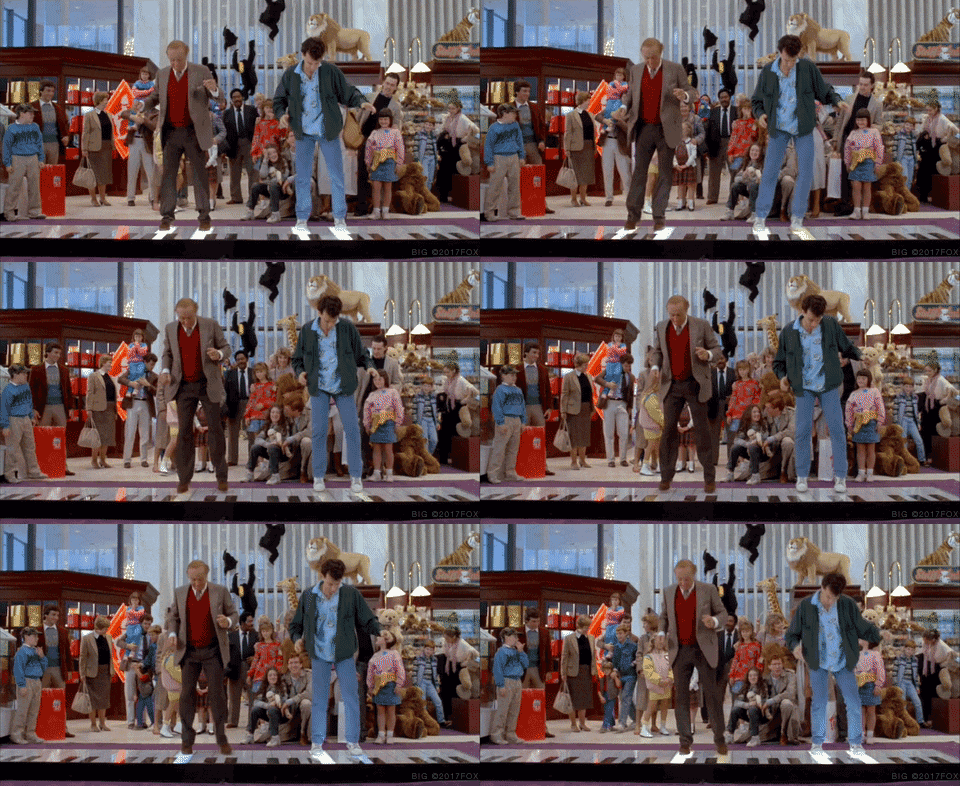
If there is a time I wish for, it is when FAO Schwarz was open and you could still play “Chopsticks” with the floor (BIG), or when Record labels made money off covers and the smalltown band you started in a friends garage could still be discovered (That Thing You Do!).
Magic was rampant in the 90s. And, as I have spent the last two weeks recovering from the threat of a haunting, most importantly – real. Take the wrong frustrations, perhaps your displeasure with the arbitrary tyranny of the “You Must Be This Tall” sign, which is as Roger Ebert so gracefully put it “a species of humiliation beyond the limits of human endurance”, out on the wrong object, a decrepit fortune-telling machine, and you get a curse. Contrived or not (like my last sentence, or pop-music if we wanna be thematic), the effect is direct. Penny Marshall & Zoltar give you exactly what you wish – to be older – and an innocuous childhood desire gets twisted into reality. Now we, the viewer, must follow poor Joshua Baskin into the hall of fun house mirrors that is BIG. Inside we’ll discover that funny is cruel, sentimental is funny, and cruel is sweet with hints of sappy because everyone’s reactions are extremely appropriate. The parents put out a missing child notice, and when he comes home, the mother screams with fear at the threat of being assaulted by an unknown man. The homeless men mutter violent pep talks. The Time Square hookers proposition you on the street. Name a more cold-blooded application of time travel, I’ll wait.4
Honestly, the premise alone provokes me. My older brother insides want to interject for Baskin before Zoltar’s ire spews to punishment, to cut in with “He didn’t mean it! He didn’t know what he was doing!” Aged viewers know adulthood isn’t a lesson anyone’s eager to pass on. So, who was this film really for? It acts like a 2-way mirror: brightly reminding the old on how to be young, darkly terrifying the young of getting old while validating their hunches of what the best parts will be. (“ONE HUNDRED AND EIGHTY-SEVEN DOLLARS!”) After Tom Hanks cries himself to sleep that first night, we could classify it as a documentary. The next morning, he gets a job, the next night, he gets used to hearing gunshots. Real.
Which is the beauty of BIG – Baskin’s ability to step right into it. The FAO store. The curse of Zoltar. His job interview. Nary a pout and rarely a breakdown (all of which fade to black), he makes the most of what he’s got – turning 30 – to capitalize on the situation. Marshall is adept here, aided by Hanks’ harmonious performance, at positioning the argument as less about children possessing an attention problem and more that they have a better absorption rate for wonder. Hanks leaps in with both feet and plenty of “Heart and Soul” by Hoagy Carmichael. Lays it out across an electric light-up floor with Robert Loggia as accompaniment. We see that once wonder is established, it doesn’t matter if it’s 3 years or 35 since you’ve played the piano: your body remembers “Chopsticks”. You can have fun.
What is your signature? The idiosyncratic sound, action, gesture which announces you. Your shorthand. Your call sign. Your biggest of small silly peculiarities. That thing you do.5 For Dean, as far as I can tell or pretend to know, it’s the way her musical theatre training has morphed her Mmmmmmm to be deep and melodic. For Tom Hanks, “America’s Favourite Son”, my 72 hours spent researching have yielded roughly three top contenders: “annoyingly friendly”, “everyman energy”, and a guarantee to be overcome by emotion when talking about Rita Wilson during an acceptance speech. (He LOVES that woman.) In his closing remarks at the 30th AFI Lifetime Achievement Award, Hanks pulls a quote from his directorial debut, That Thing You Do!, which trademarks a familiar sentiment for those graced by fame; “Skitch, how did we get here?” How did she (Olivia Dean) go from corralling 70 people into a bar with 6 of them sitting on the stage, to holding 20,000 at the O2 six nights in a row? How did he (Tom Hanks) go from high school plays in Oakland, California to among the most distinguished filmographies of the last two decades?
You should know the first time I saw his movie was in a park, on a ratty patch of grass, and I wasn’t paying much attention. I can’t tell you how “The Wonders” made it onto a late-night show featuring Bryan Cranston as an astronaut – I was as shocked as Guy’s mom. That time was also the director’s cut; swelling with Tom’s extra 45 minutes for this charismatic tale about the meteoric rise-and-fall of a one-hit wonder pop band from Pittsburgh. If you’re wondering how many more plays of the title track that brings us, the running guess is 12. It also brings maturity to the storyline and supporting characters. You get more of everyone’s “thing” – Faye’s faithfulness, Guy’s smarts, White’s militancy, Tina’s tryst, Leo’s goofball one-liners, and Jimmy’s brooding artistry – which lends credibility to how the band breaks-up. Incensed at the idea of playing covers and partly sulking from Faye’s apt dismissal of their relationship6, “genius” Jimmy sings his best original song: “I quit…”. Snappy, up-tempo, to the point. A perfect response after Mr.White exposes the wiles of a recording contract. A very common tale.
There is one requirement for nostalgia: use it well. There is a similar requirement for covers: do it well. If you’re going to go back in time – GO BACK IN TIME! If you’re going to sing another artist’s song – meet the standard. That’s why we have them. That’s what they’re there for. That’s, in fact, the whole notion behind their naming. These are exercises in innovation. Variations on a theme. Distort time to create something fresh from what was undeniable. Like the boozey delight of Duke Ellington’s “Sugar Rum Cherry”, or the piercing woes of Bon Iver’s “Can’t Make You Love Me”, or the soothing hug of Mavis Staples’ “Godspeed”. Remember songs are meant to be shared.

Olivia Dean hasn’t forgotten, too! Her love for covers could be traced back to her middle name, “Lauryn”, after The Ms. Lauryn Hill (a fellow recipient of the Best New Artist award) who has made a killing reviving sonic classics. In a reverse passing of the baton, the song I’d like to plug for either a refreshed synch or a great cover is Hill’s version of “Can’t Take My Eyes Off of You”. The song, like Dean, is simply too good to be true with its beatbox percussion and swanky production. I give it, Dean, Hill & Hanks, all the awards and tell you to watch this space.
P.S. What’s a song that your sole explanation for knowing is, “You had to be there.”?
Supposing she’s also a Pisces, what then?

I write this knowing full well Re:ZERO -Starting Life in Another World exists…
For me, it’s my laugh. You’re gonna hear me coming before you see me coming.
"I have wasted thousands and thousands of kisses on you - kisses that I thought were special because of your lips and your smile and all your color and life. I used to think that was the real you, when you smiled. But now I know you don't mean any of it. You just save it for all your songs. Shame on me for kissing you with my eyes closed so tight."